The second we turned onto St. George Street, my wife grabbed my arm and went dead silent. That’s how you know a place got her. She’s seen a lot of cities. But this one stopped her mid-sentence.
We spent a full weekend in St. Augustine, Florida — the oldest city in America — and I’m still thinking about it weeks later. Not in a “that was nice” kind of way. In a “why don’t more people talk about this place” kind of way.
So here are the 10+ best things to do in St. Augustine, Florida.
St. George Street — Start Right Here
Don’t even think about checking into your hotel first. Drop your bags and come straight here.
St. George Street is a pedestrian strip that runs through the heart of the historic district and it is CHARMING in the best possible way. Narrow cobblestone road. Balconies hanging overhead. Palm trees everywhere. Spanish-influenced buildings packed together like they’ve been there for 300 years — because a lot of them have.
The first thing that hit me was just how walkable everything is. No giant parking lots. No strip malls. Just this beautifully compact little stretch of history where you can wander for an hour without covering much ground at all, and somehow that’s a good thing.
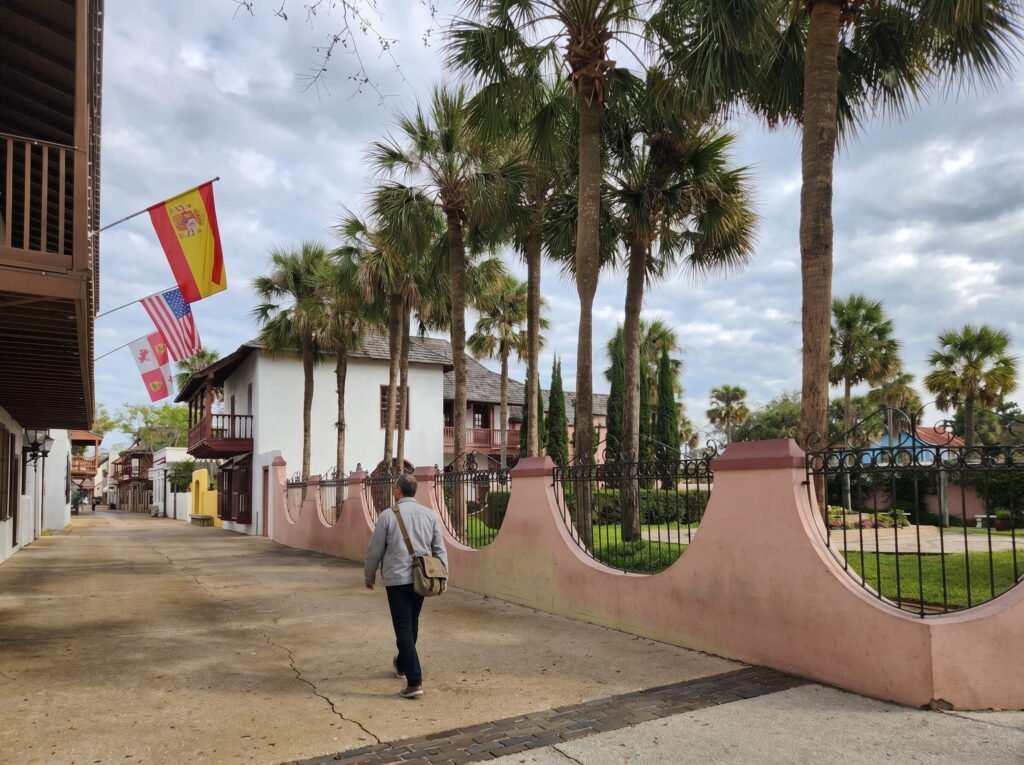
I thought it might feel touristy and hollow. I was completely wrong. Yes, there are shops. Yes, there are crowds on weekends. But the bones of this place are so real that even the busiest afternoon can’t take away from it.
A few things to know:
- It’s free to walk. Shops and restaurants obviously cost money but the street itself is open to everyone.
- Go in the morning if you want more breathing room. Afternoon crowds build fast in summer.
- The heat in June is no joke. Bring water. Bring a lot of water.
The Oldest Wooden Schoolhouse in the Country
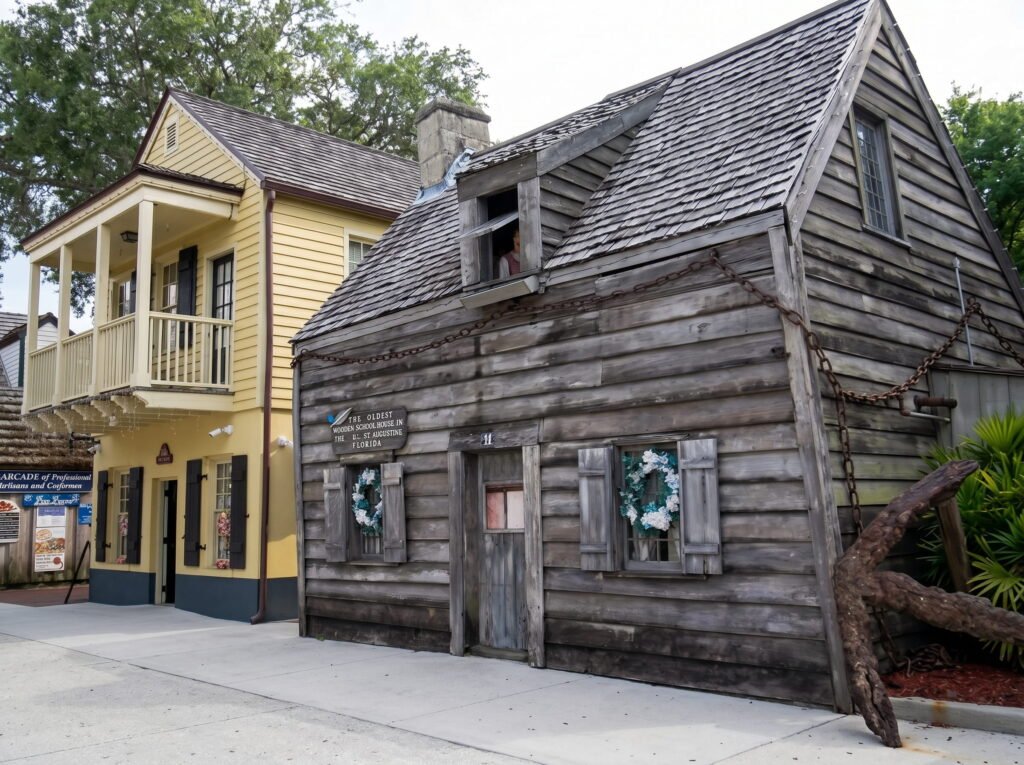
Right along this stretch you’ll pass a small sign pointing to the “Oldest Wooden Schoolhouse” in the United States. Built sometime before 1716 — they’re not exactly sure of the date, it just showed up on tax records that year — out of red cedar and bald cypress.
It’s small. It looks like something from a storybook. And for a few seconds standing in front of it, you actually feel the weight of that number. 1716. That’s not history from a textbook. That’s right in front of you.
It’s a quick stop. You’re not spending an hour here. But walking past it without acknowledging it would be a shame.
Castillo de San Marcos — Older Than You Think
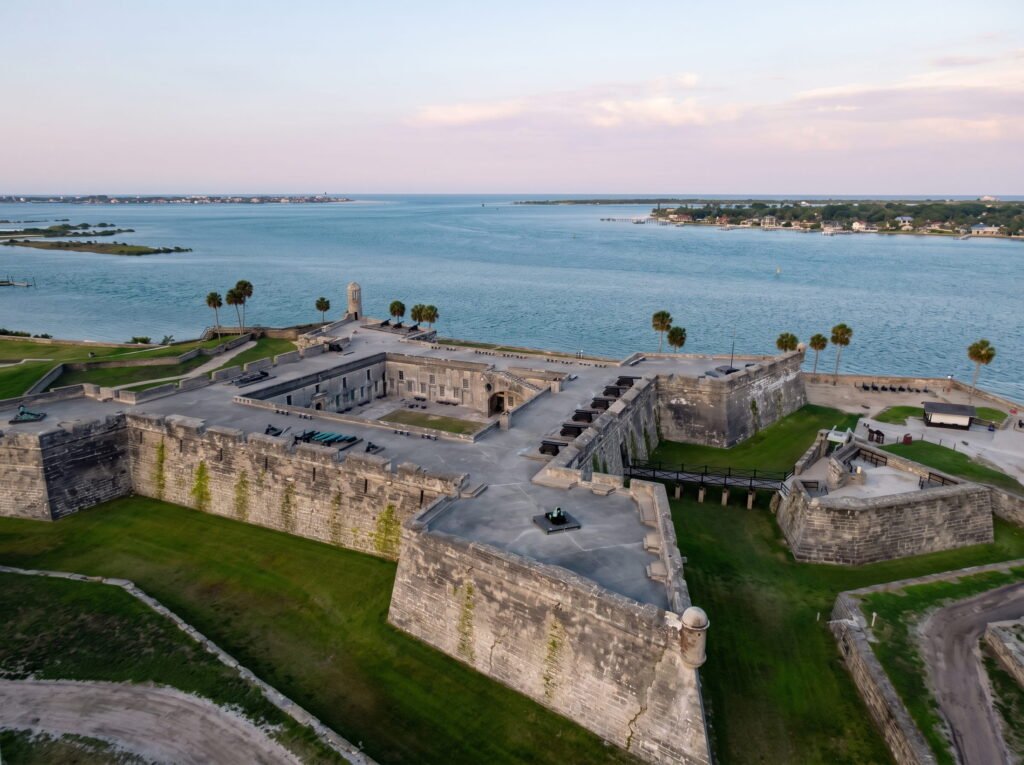
From St. George Street there’s a path that leads you right out to the bay and straight to the fort. Follow it.
The Castillo de San Marcos is the oldest masonry fort in the entire continental United States. Construction started in 1672. The Spanish built it out of coquina — a mix of shell fragments and sand — after an English privateer burned most of St. Augustine to the ground in 1668. They weren’t going to let that happen again.
Pirates actually took this fort at one point. It survived cannon fire. It survived multiple sieges. The walls didn’t crumble because coquina absorbs impact instead of shattering. The Spanish basically accidentally invented impact-resistant construction in the 1600s.
Admission right now runs $15 per adult, and kids 15 and under get in free. Between the two of us that was $30, which felt completely worth it. The fort sits right on Matanzas Bay and the views alone would justify the entry.
Weekend cannon demonstrations happen multiple times a day — 10:30am, 11:30am, 1:30pm, 2:30pm, and 3:30pm on Saturdays and Sundays. We caught one. It was loud in a way that made us both jump and then laugh immediately.
The ceilings inside the fort are low. I’m not a tall guy and I was ducking. Just a heads up if you’re bringing kids who will definitely try to run through those corridors.
The Cathedral Basilica — Quietly Stunning
Just off St. George Street stands the Cathedral Basilica of St. Augustine and I almost walked past it without going in. That would have been a mistake.
Built in 1797, it’s this unique combination of neoclassical and Spanish architecture that sounds like it shouldn’t work together but absolutely does. The building has real presence. You notice it before you read any signs about it.
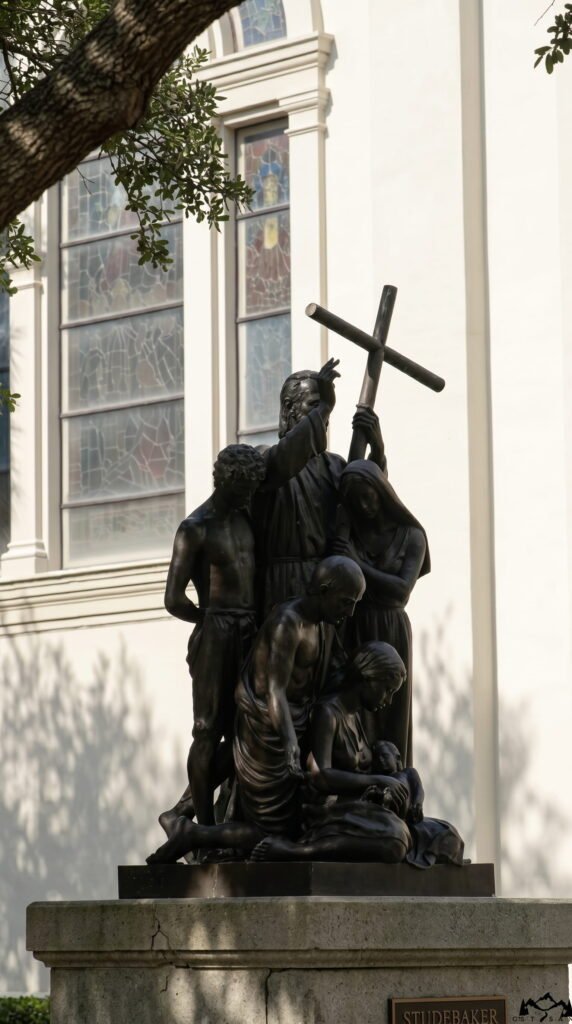
Inside is calm. Quiet. Beautifully preserved. There’s a painting inside I’m almost certain is of Pedro Menéndez — the man who actually founded this city in 1565 — though I couldn’t confirm it in the moment.
Entry is free. Takes maybe 20 minutes. Worth every second of those 20 minutes.
The Lightner Museum — This One Surprised Me
Okay, so I was not that excited about this one. Diyana wanted to go. I went along without much enthusiasm. And then I walked in and immediately felt bad about my low expectations.
The building alone is worth it. Originally the Hotel Alcazar, built in 1887 in Spanish Renaissance style by Henry Flagler — Standard Oil money — this place was once one of the most extravagant hotels in Florida. The indoor swimming pool on the first floor was reportedly the largest in the world at the time. Now there’s a cafe there. Which is both a little sad and also extremely charming.
The museum itself holds Otto Lightner’s collection of 19th century art, furniture, instruments, curiosities, and Tiffany stained glass. It’s spread across four and a half floors and you can spend a solid two hours here without realizing it.
Admission is $20 for adults, $17 for seniors and students. We went right before lunch and had most of the upper floors to ourselves. The courtyard in the middle is open to the public — shops and all — even if you don’t buy a museum ticket, which is a nice touch.
Across the street from the Lightner sits Flagler College. It was built in 1888 as the Ponce de León luxury hotel and became a college in 1968. We didn’t go inside but we stopped and stared at it from the sidewalk for a solid three minutes. It looks like a palace.
That Statue of Don Pedro Menéndez
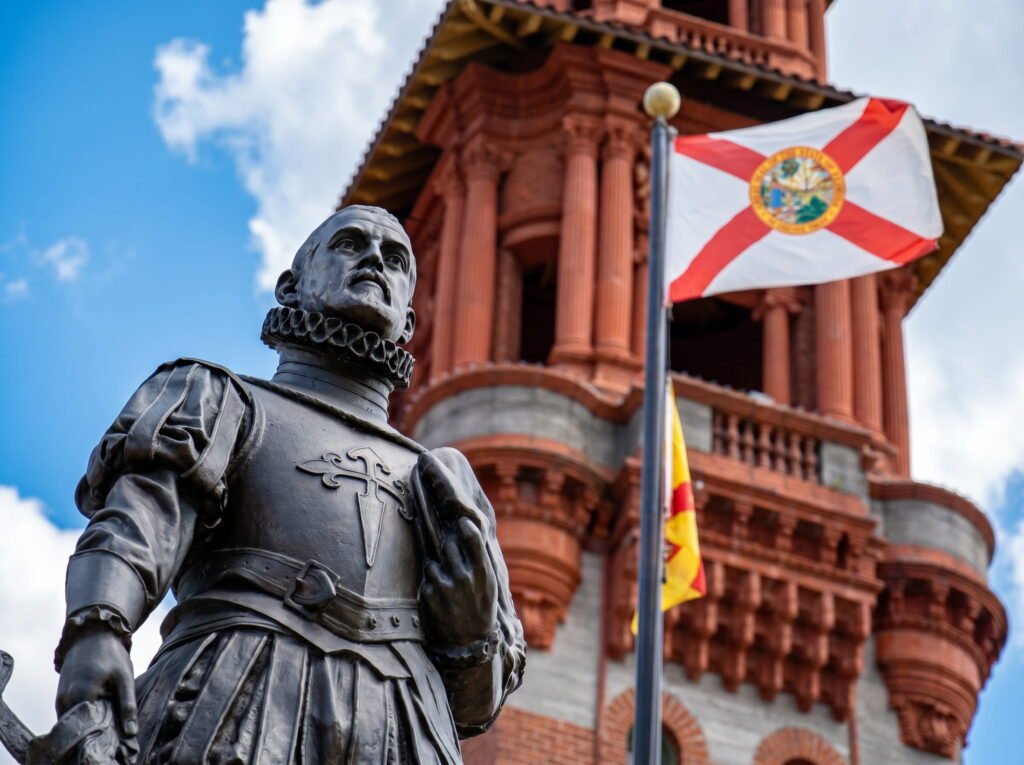
Inside the Lightner’s courtyard there’s a statue of Don Pedro Menéndez de Avilés — the Spanish admiral who founded St. Augustine on September 8th, 1565. I kept coming back to this figure throughout the whole trip.
Here’s the distinction that confused me until I looked it up: Juan Ponce de León discovered Florida and landed near this area in 1513. But Menéndez was the one who actually founded the permanent settlement 52 years later. They’re different people, different eras, both tied deeply to this place.
The old Senator oak tree near the Fountain of Youth — which we got to later — is over 600 years old. Which means when Ponce de León showed up in 1513, that tree was already 100 years old. I keep thinking about that.
Ponce de León’s Fountain of Youth — Drink the Water
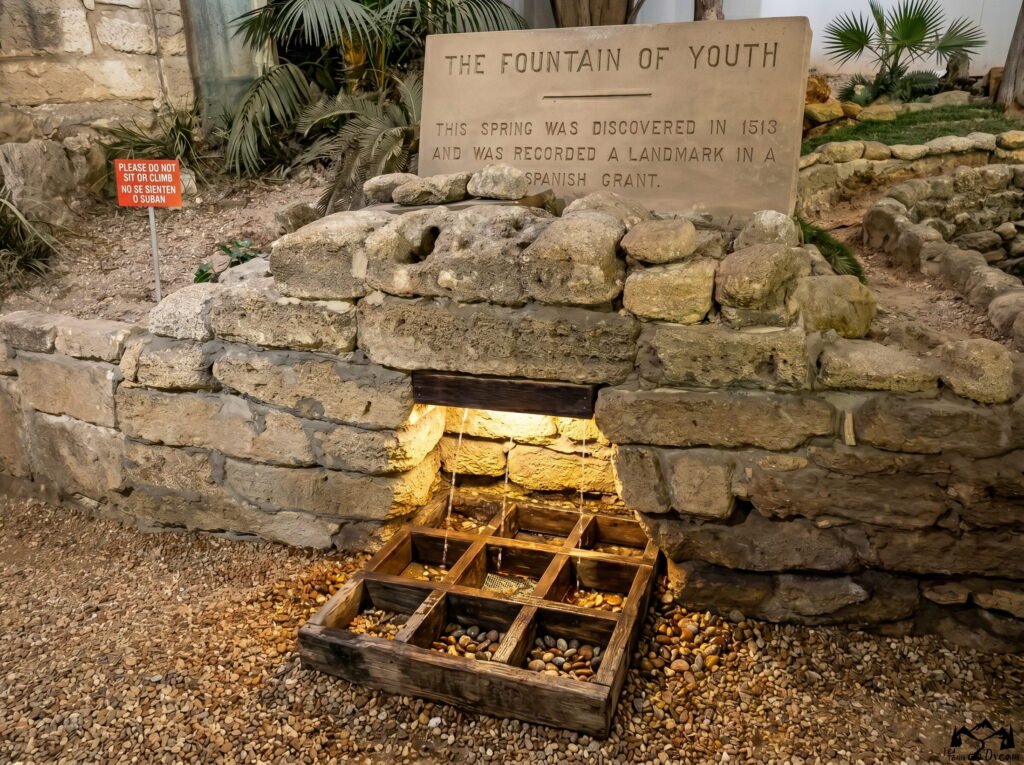
I thought this would be cheesy. It is a little cheesy. But it’s also genuinely interesting and way more layered than I expected.
The Fountain of Youth Archaeological Park is a 15-acre waterfront property that sits on the site of the first European settlement in St. Augustine. There’s an actual working archaeological dig on the grounds. There’s a reproduction of the Spanish settlement. There’s a Timucuan Indian village exhibit. There are peacocks wandering around freely because why not.
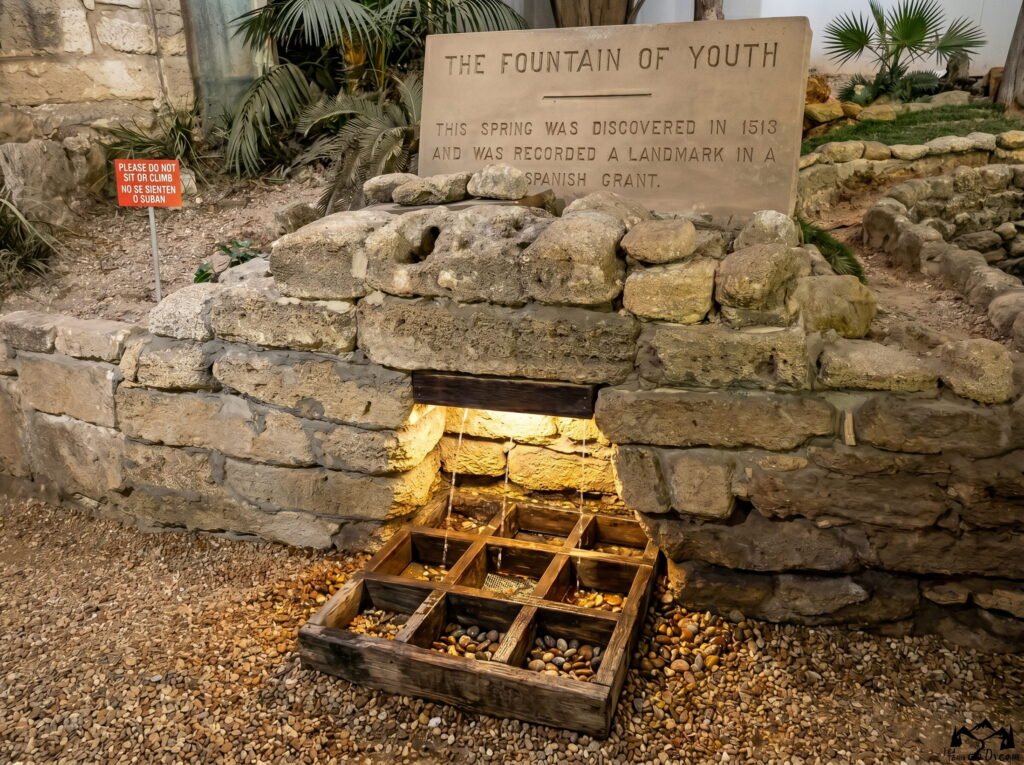
And then there’s the spring. The legendary Fountain of Youth that Ponce de León reportedly found in 1513. You take a cup and drink the water straight from it.
Was I getting younger? Probably not. Did it taste noticeably mineral-y in a way that suggested layers of limestone filtration and over 30 dissolved minerals? Yes, actually. It’s not bad. It’s just distinctly water from the ground.
There’s also a coquina cross on the property that was carbon dated and reportedly hasn’t been moved since Ponce de León’s crew planted it here in 1513. Standing next to something like that and actually believing it changes the way you look at the rest of the day.
Admission is $22.95 for adults, $20.95 for seniors. Parking is free, which matters because downtown parking is a whole situation. Between the two of us it came to just under $46.
A few things to know:
- Open daily 9am–6pm, last ticket at 5pm.
- Cannon firing demonstrations happen throughout the day.
- Those peacocks will walk right up to you.
Mission Nombre de Dios and the Big Cross
Just up the road from the Fountain of Youth, and this one is free.
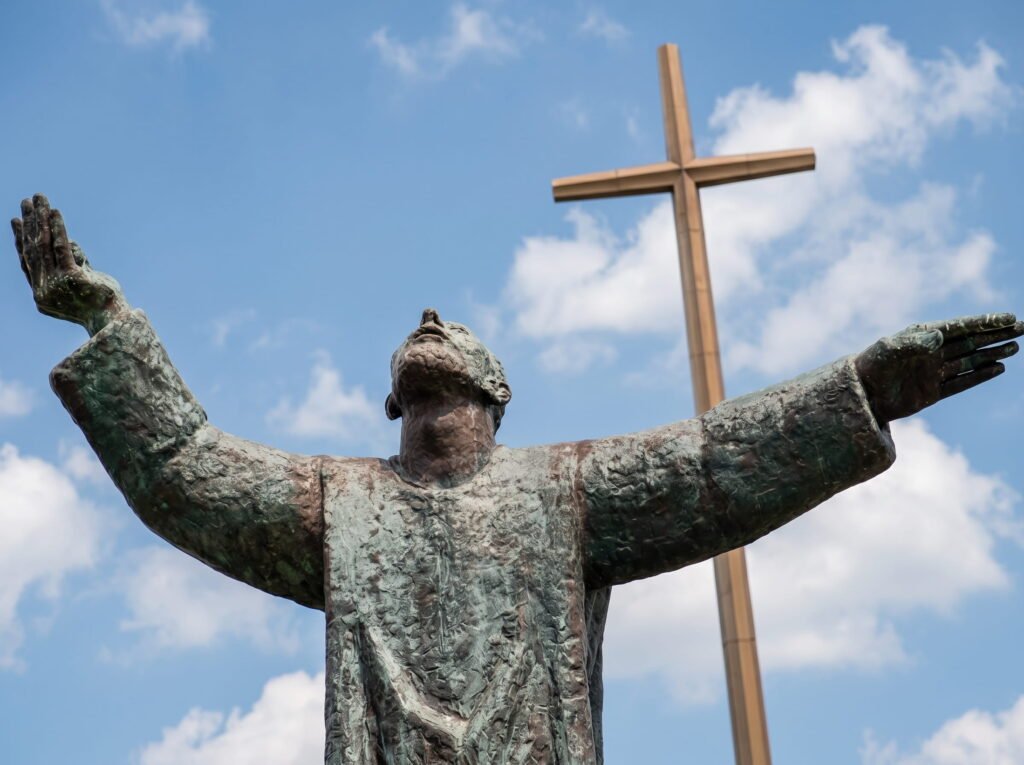
The Mission Nombre de Dios is where Pedro Menéndez reportedly landed when he arrived to found the settlement. There’s a 208-foot stainless steel cross marking the spot — you can see it from the river, from downtown, from the lighthouse. It dominates the skyline in that part of the city.
There’s a statue of the very first priest in America on the grounds. According to what we read, the absolute first thing the settlers did when they arrived was set up for mass. That priest led it. Standing next to his statue and looking out at the bay, that detail hits differently than it would in a textbook.
On the same property is the Shrine of Our Lady of La Leche — the oldest shrine in America, first built in 1615 and rebuilt multiple times after war, storms, and pirates. The current structure dates to 1918. Small. Simple. Real.
The museum here also holds the original casket of Pedro Menéndez. That detail alone made my wife stop walking for a moment.
All of it is free. The whole property. The museum, the cross, the shrine.
St. Augustine Lighthouse — Climb It. Yes, All 219 Steps.
I’m not good with heights. I will just say that upfront.
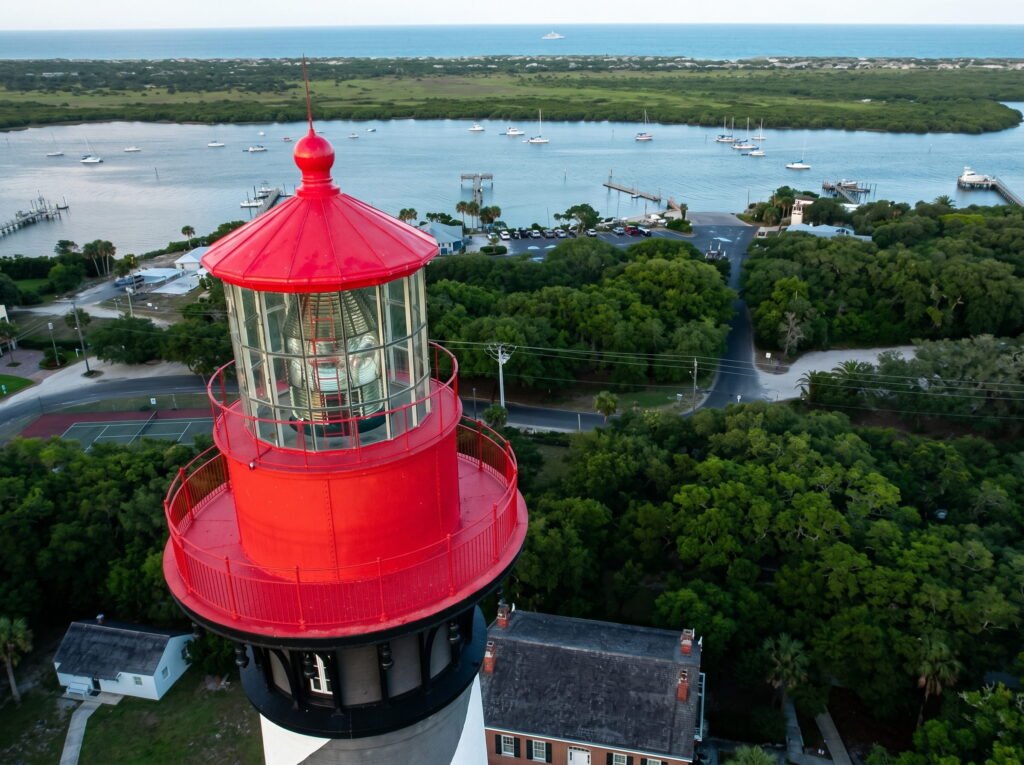
We pulled up to the lighthouse on Anastasia Island and I looked up at that 165-foot black and white spiral tower with the red cap and felt a very reasonable amount of dread. The lighthouse was built in 1874 out of brick specifically because every wooden watchtower the Spanish built before it kept burning down. They eventually got the message.
When it was completed it was the tallest building in all of Florida.
General admission is around $14.95 for adults, $12.95 for kids and seniors. That includes everything on the property — the exhibits, the keeper’s house, nature trails, and the tower climb if you’re tall enough (kids need to be at least 44 inches).
I made it to the top. Every step of the 219 stairs felt like a commitment I was regretting. And then I got to the top and looked out over the whole city, the beaches, the bay, the lighthouse beam — and every single doubt evaporated. COMPLETELY worth it.
The view up there is genuinely one of the best things I have ever seen from a high place.
Coming down felt faster, though my legs were shaking in a way I found mildly embarrassing.
St. Augustine Alligator Farm — Don’t Skip This
I almost put this one lower on the priority list. Glad I didn’t.
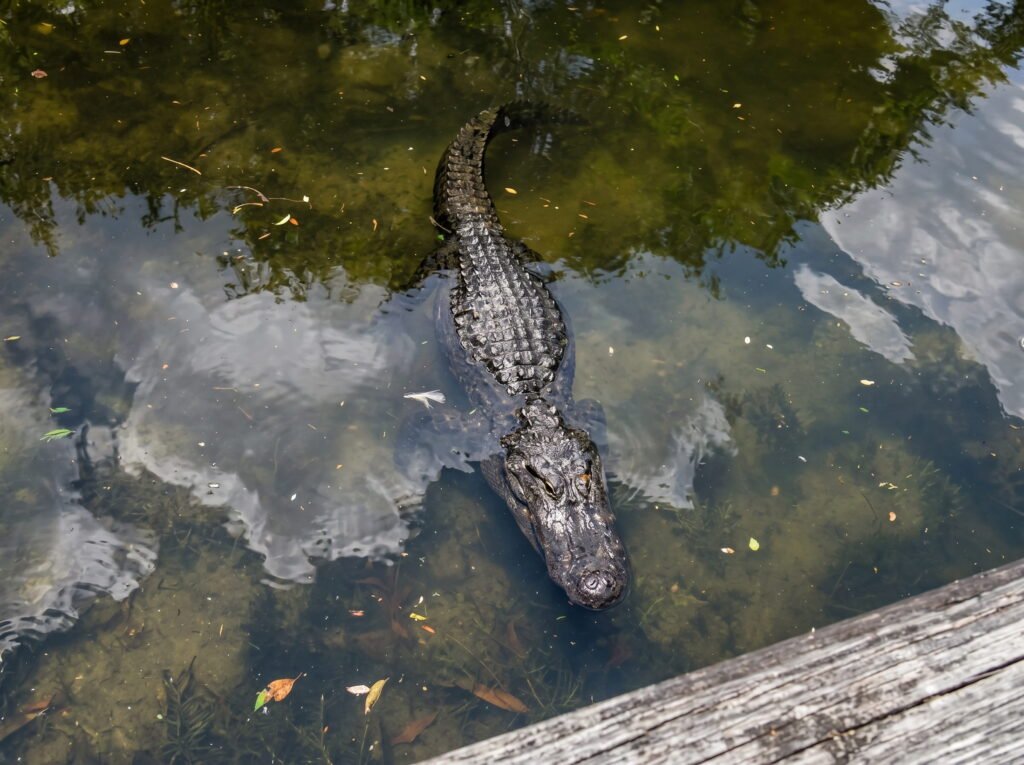
Open since 1893, the St. Augustine Alligator Farm and Zoological Park is the only place in the world where you can see all 24 living species of crocodilians in one spot. When I say there can be 800 to 1,000 alligators and crocodiles at once on this property — that number doesn’t feel real until you’re standing on a boardwalk looking out at a pool absolutely PACKED with them.
We saw an Indian Gharial up close and it looked like something from a different planet. That long narrow snout. The sheer size of it. My wife called it pretty. I disagreed loudly.
Current admission is around $29.99 to $34.99 for adults depending on where you book — buying online in advance is the move. Kids ages 3–11 run about $18.99–$19.99. Open daily 9am–5pm, with extended hours to 6pm in summer.
What I genuinely loved about this place is that many of the animals aren’t caged in the way you’d expect. Birds nesting. Turtles roaming. It felt more like observing wildlife than visiting a zoo. The birds nesting above the gator pools — unbothered, completely wild — was something I’ve never seen anywhere else.
There’s also a zip line course called Crocodile Crossing that soars over actual alligators. We did not do the zip line. I had already used up my bravery at the lighthouse.
The Old Senator Oak Tree — Pull Over
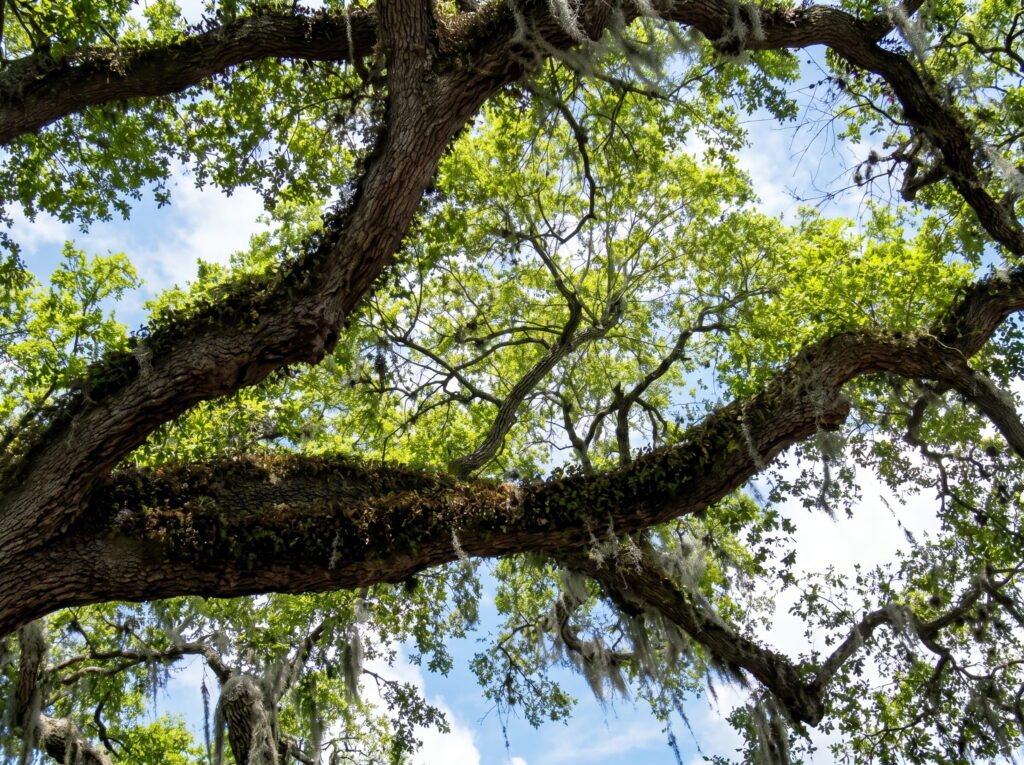
About a mile outside downtown there’s an old oak tree sitting beside a motel that looks almost unremarkable at first glance. Until you read the sign.
This tree is over 600 years old.
That means it was already a century old when Ponce de León first set eyes on Florida in 1513. He probably passed right by this exact tree. And it’s still here. Covered in Spanish moss. Completely unbothered by history.
The motel put out chairs underneath it. We sat for maybe 10 minutes just existing under a 600-year-old oak. It’s one of the stranger and more peaceful moments of the whole trip.
It’s free. It’s just a tree. But it’s a tree that has been watching this city since before the city existed.
The Bridge of Lions and Downtown Wandering
The Bridge of Lions connects downtown St. Augustine to Anastasia Island and it has two marble lion statues standing at the western entrance. They’re striking. I kept noticing them from different angles throughout the day.
We found out later that Pedro Menéndez de Avilés — the founder of the city — had two lions on his personal coat of arms. Once you know that, you start spotting lion imagery all over downtown. They’re on buildings, gates, signage. The whole city is quietly honoring the man who started it.
The boardwalk along the Matanzas River is worth an easy stroll. It’s free, it has a sea breeze that makes Florida summer bearable, and you can see the lighthouse, the big cross, and the Spanish architecture of downtown all from the same view. We did this late in the afternoon when the heat broke a little and it was about as peaceful as a city walk gets.
The Nao Trinidad — If It’s There, Go
This one is seasonal, so check before you plan around it.
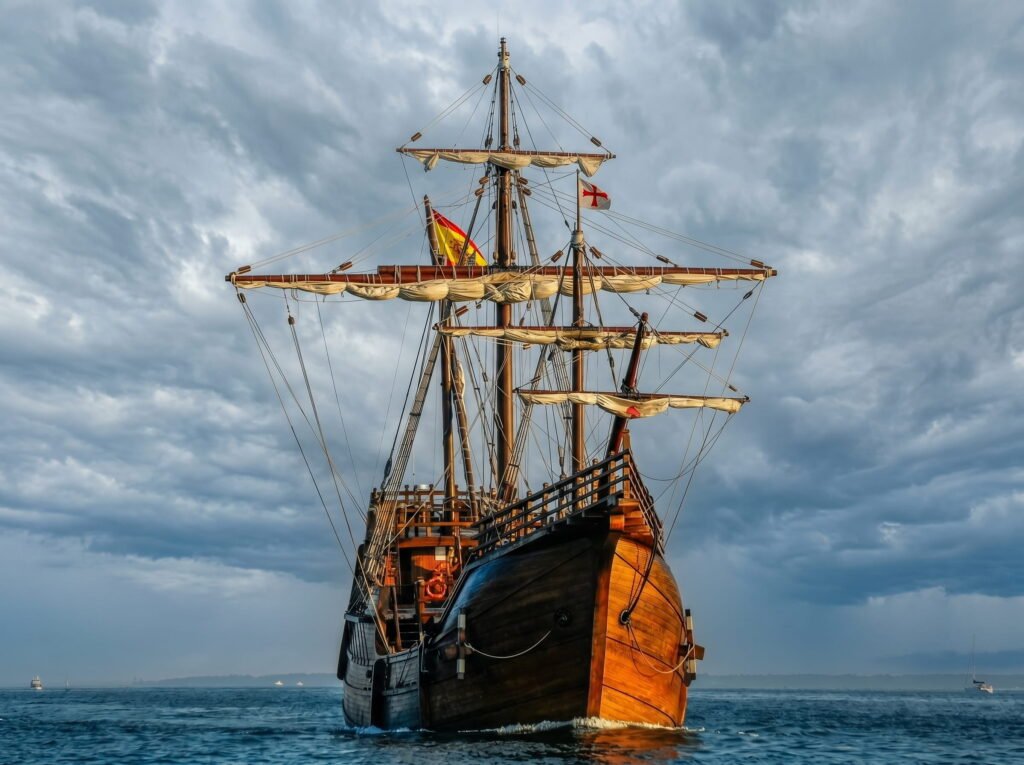
The Nao Trinidad is a 1519 Spanish replica exploration ship — one of four vessels that originally sailed from Spain across the Atlantic and discovered the Strait of Magellan. When it docks in St. Augustine you can board it and walk through what those voyages actually looked like.
We went on board and it immediately recalibrated how I understood what those early explorers were doing. The ship is small. Like, remarkably small for crossing an ocean. I kept thinking about 16th century sailors packed onto this thing in the middle of the Atlantic.
It was so cool it felt almost unfair that it’s only here sometimes.
Where to Eat — Beaches at Vilano
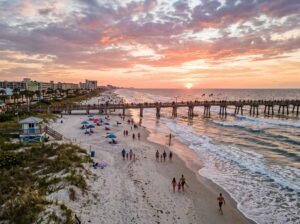
When the afternoon heat peaked and we needed to eat, we crossed over to the Vilano side and had lunch right on the water at a restaurant on the pier. I got the fish sandwich — solid, fresh, exactly what you want after a day of walking. Heidi went with coconut shrimp and hush puppies and she was extremely happy about that decision.
Watching people fish off the pier while eating felt like the right speed after a day packed with history.
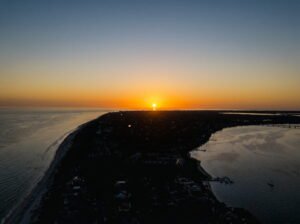
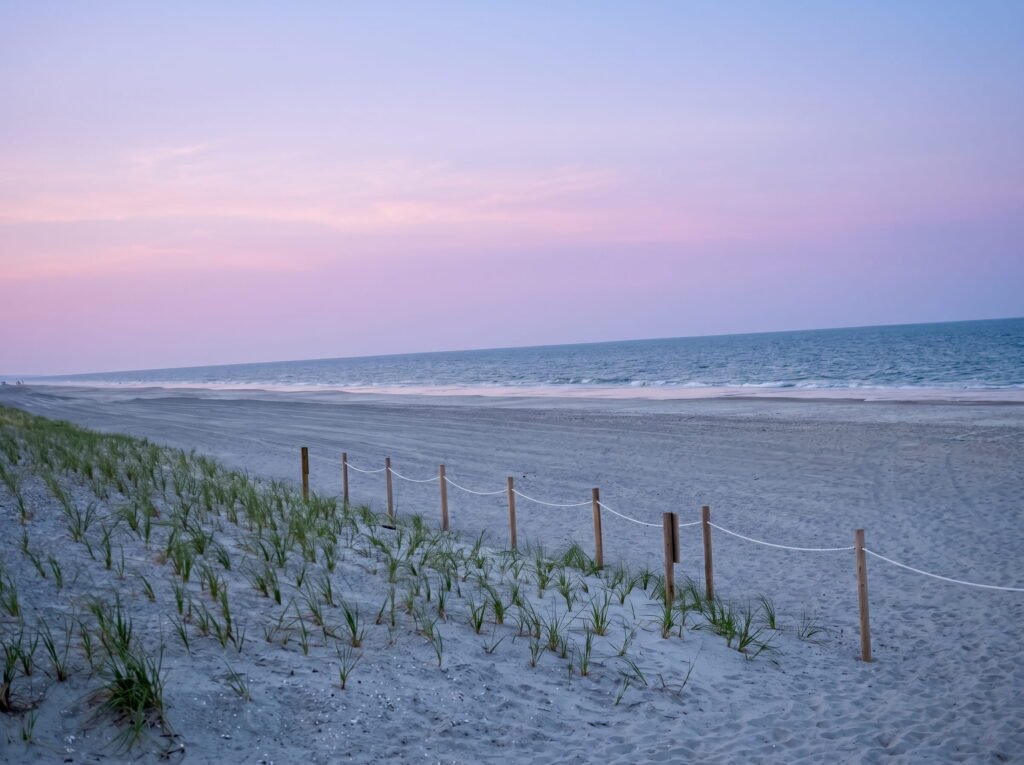
After lunch we walked over to Vilano Beach itself. It was late afternoon, the crowds had thinned, the sun was starting to lower. We barely talked. Just walked and looked at the water.
Other beaches worth knowing about in the area: Ponte Vedra Beach, Butler Beach, St. Augustine Beach, and Crescent Beach. Each has a slightly different feel. We didn’t get to all of them this trip but they’re on the list.
The Gonzalez–Alvarez House and Villa Zorayda
Two buildings close to each other downtown that are easy to work into an afternoon walk.
The Gonzalez–Alvarez House is the oldest house in St. Augustine — construction dates to around 1723 — and it’s now a museum. Just standing outside it and doing the math on how long ago that was is worth a moment.
Across the street, Villa Zorayda was built in 1883 by a Boston millionaire named Franklin W. Smith. He modeled it after the 12th century Moorish Alhambra Palace in Spain and used it as his personal winter home. He’s also — and this detail is just random enough to be real — reported to have danced with his wife at Abraham Lincoln’s inaugural ball in 1861.
It’s a museum now. The building is strange and beautiful in a very specific way that feels out of place in Florida, which is exactly why you should look at it.
Memorial Presbyterian Church
Last stop of our weekend, almost by accident.
The Memorial Presbyterian Church was established in 1889 and it’s sitting right there in the historic district looking like something you’d find in Europe, not Florida. We walked up to it around dusk and the light hitting the architecture made both of us stop.
We didn’t go inside that evening. But we stood there for a while.
That’s kind of how St. Augustine works. You keep turning a corner and finding something that stops you. Not because it’s trying to impress you. Just because it’s been here so long that it’s earned the right to be impressive without even trying.
Things You Should Know Before You Go
A few things to know that I wish someone had told us:
- Come in June and bring a hydration pack. The humidity is extreme. We had ours going almost every day.
- Everything in the historic district is close together and walkable. You don’t need a car for most of the main attractions.
- The alligator farm and lighthouse are on Anastasia Island, about a mile from downtown — easy drive or rideshare.
- Many of the big attractions have free parking, which matters when downtown meters are tight.
- If you visit on a weekend, the Castillo does cannon demonstrations multiple times — time your visit around one.
- Weekday mornings on St. George Street are significantly quieter than weekend afternoons.